MOSS: the best similarity score did not mean the fewest word errors
Nine generator profiles were tested against BF16 plus the same Argentina LoRA. The English study retained ninety complete generations, controlled decoder runs and a timing recheck. A separate Spanish extension used one generation per phrase.
Key finding
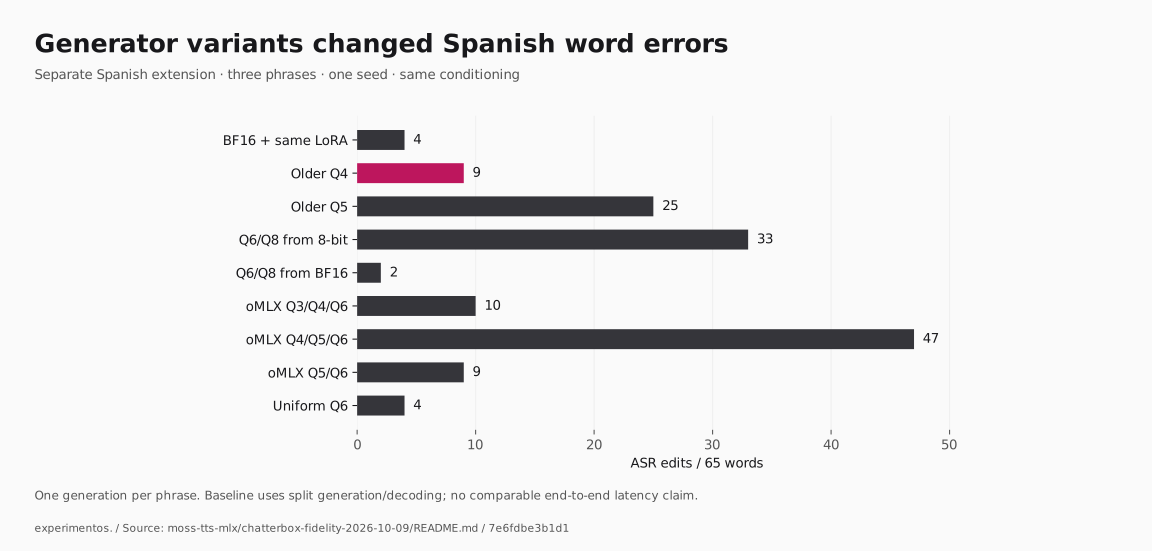
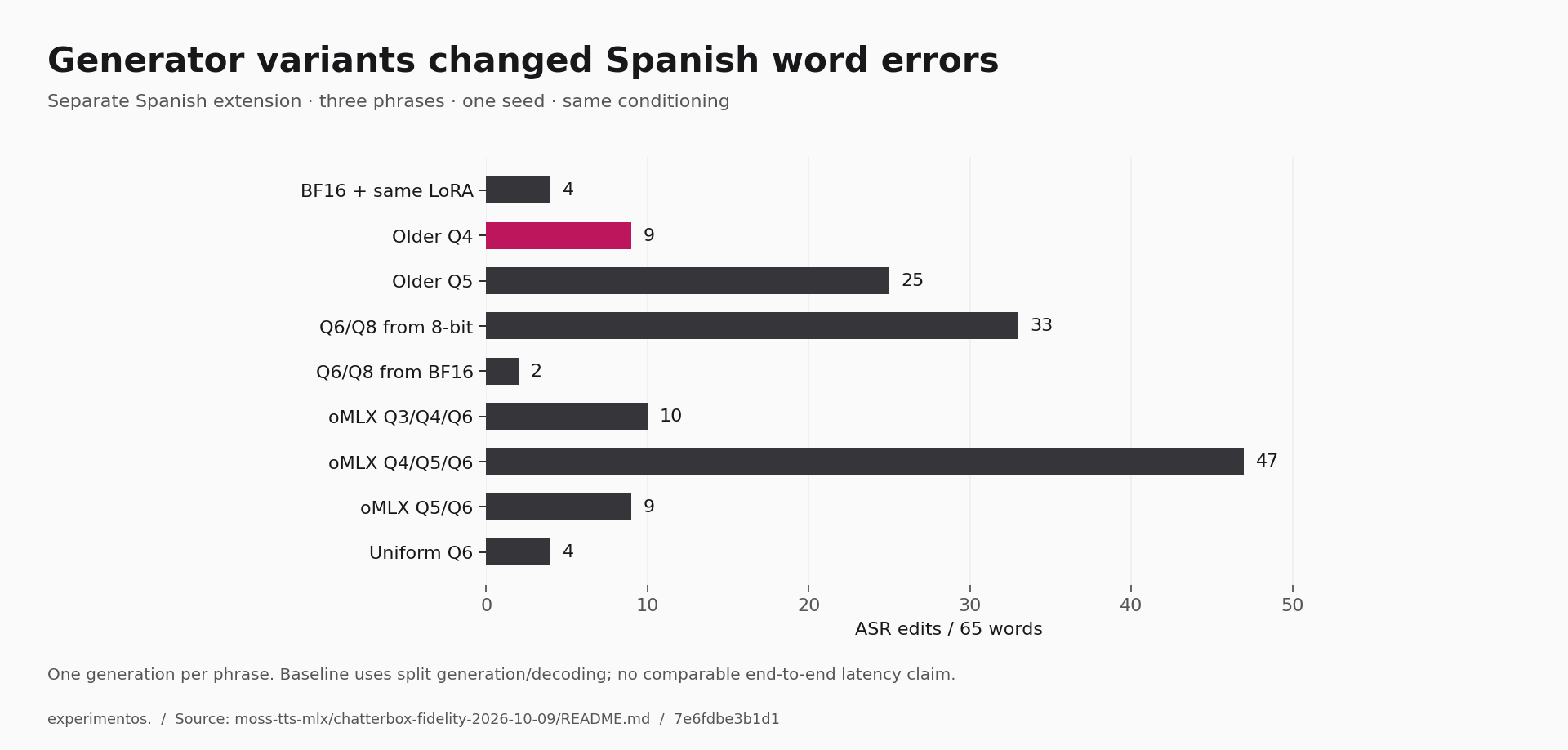
Q6/Q8 built directly from BF16 had the fewest Spanish ASR edits, while the older Q4 had higher speaker cosine.
Edited finding from the pinned experiment record. The report and figure metadata preserve the original workload and limits.
The boundary
Three phrases per language, one seed and one reference voice. The unchanged shared codec makes decoder controls consistency tests, not a generator ranking.
Data
Reviewed aggregate results with explicit units, sources and qualification limits. Different cohorts remain separate.
Generator variants changed Spanish word errors
Separate Spanish extension · three phrases · one seed · same conditioning
- BF16 + same LoRA4
- Older Q49
- Older Q525
- Q6/Q8 from 8-bit33
- Q6/Q8 from BF162
- oMLX Q3/Q4/Q610
- oMLX Q4/Q5/Q647
- oMLX Q5/Q69
- Uniform Q64
ASR edits / 65 words
One generation per phrase. Baseline uses split generation/decoding; no comparable end-to-end latency claim.
View data & source
| Configuration | Value |
|---|---|
| BF16 + same LoRA | 4 |
| Older Q4 | 9 |
| Older Q5 | 25 |
| Q6/Q8 from 8-bit | 33 |
| Q6/Q8 from BF16 | 2 |
| oMLX Q3/Q4/Q6 | 10 |
| oMLX Q4/Q5/Q6 | 47 |
| oMLX Q5/Q6 | 9 |
| Uniform Q6 | 4 |
Origin: reviewed report table. Revision 7e6fdbe3b1d1.
Write-ups
Report moss-tts-mlx/chatterbox-fidelity-2026-10-09/README.md
Porting the evaluation method
Nine generator profiles were tested against BF16 plus the same Argentina LoRA. The English study retained ninety complete generations, controlled decoder runs and a timing recheck. A separate Spanish extension used one generation per phrase.
Two metrics, different answers
The directly-from-BF16 Q6/Q8 profile had 2/65 Spanish ASR edits and numerical weight RMS error 2.127%. Older Q4 had 9/65 edits but higher Spanish speaker cosine, 0.95181 versus 0.91631. A Q4/Q5/Q6 mix had a fast 8.167-second English warm median yet 47/65 Spanish edits.
All controlled decoder outputs matched because every generator profile reused the same codec and codes. That verifies the pipeline control, while saying nothing about which quantized generator preserves the best voice.
Preserve the uncomfortable evidence
Forty-two of ninety complete English clips approached the 400-token ceiling. The original reference encountered severe memory pressure and repeated words. Spanish BF16 generation and decoding had to run in separate processes after failed attempts, so that extension has no comparable full-pipeline latency claim.
The useful finding is a trade-off between storage, content and identity proxies. Larger frozen corpora and human listening should precede a general recommendation.
Evidence and publication boundary
This is an edited account of the recorded experiment. The linked archive is private; the methods, aggregate findings and limits are included above. Reference recordings, raw conversations, authentication material and workstation configuration are excluded.
More in Speech & codecs
MOSS on a 3090: Q2 failed, AWQ4 stayed closer
Every profile began with the pinned BF16 generator. The comparison reused fixed reference codes and an FP32 decoder for the main quality measurements, keeping codec changes separate from generator quantization.
AWQ4 stayed close to the BF16 reference on WavLM and character errors; the sensitivity Q2 candidate was rejected.
Drama3: BF16 decoded the same codes about three times faster
The experiment replayed saved Spanish and English codes representing 21.5481 and 15.8824 seconds of audio. It compared FP32, BF16, mixed BF16 and two INT8 decoder variants on one RTX 3090.
BF16 reduced median decoder time from 390.07 to 129.54 ms in Spanish and from 292.42 to 96.88 ms in English.
Keeping FP32 and moving Supertonic to Triton
Rather than reduce the CPU graph precision again, this follow-up used NVIDIA Triton’s ONNX backend with CUDA execution and the unchanged FP32 graphs. The paired comparison retained both speed and acoustic checks.
The paired GPU test cut median first-audio time to about 0.35 seconds while preserving the measured ASR results.