Balancing GPU experts when the model will not fit
The quant was larger than the three GPUs could hold on their own. The experiment tested explicit GPU expert splits with CPU offload and measured the decode effect under the same large-context workload.
Key finding
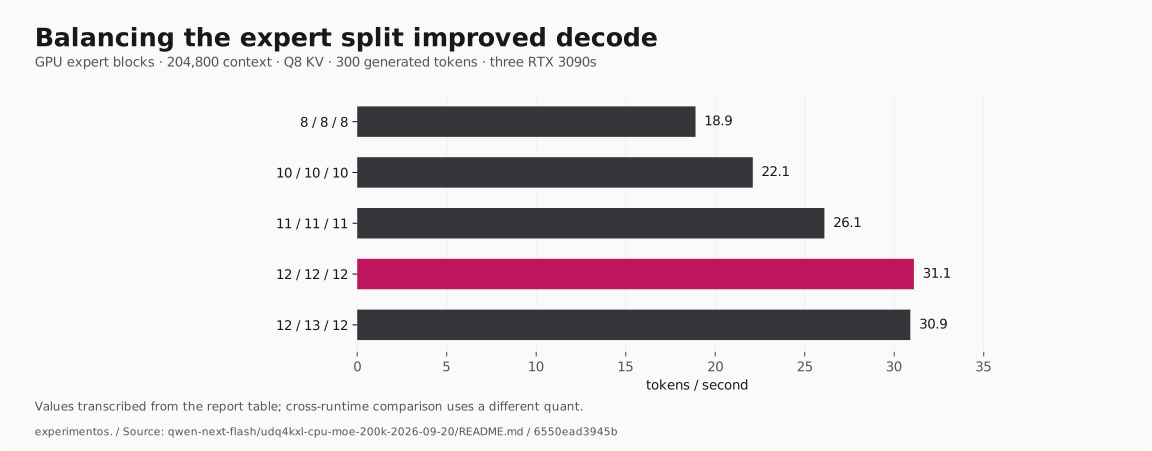
An explicit 12/12/12 GPU expert split plus 12 CPU blocks measured 31.1 tokens per second.
Edited finding from the pinned experiment record. The report and figure metadata preserve the original workload and limits.
The boundary
The 104-GiB quant requires CPU offload on this workstation. Cross-runtime reference points are not a controlled A/B.
Data
Reviewed aggregate results with explicit units, sources and qualification limits. Different cohorts remain separate.
Balancing the expert split improved decode
GPU expert blocks · 204,800 context · Q8 KV · 300 generated tokens · three RTX 3090s
- 8 / 8 / 818.9
- 10 / 10 / 1022.1
- 11 / 11 / 1126.1
- 12 / 12 / 1231.1
- 12 / 13 / 1230.9
tokens / second
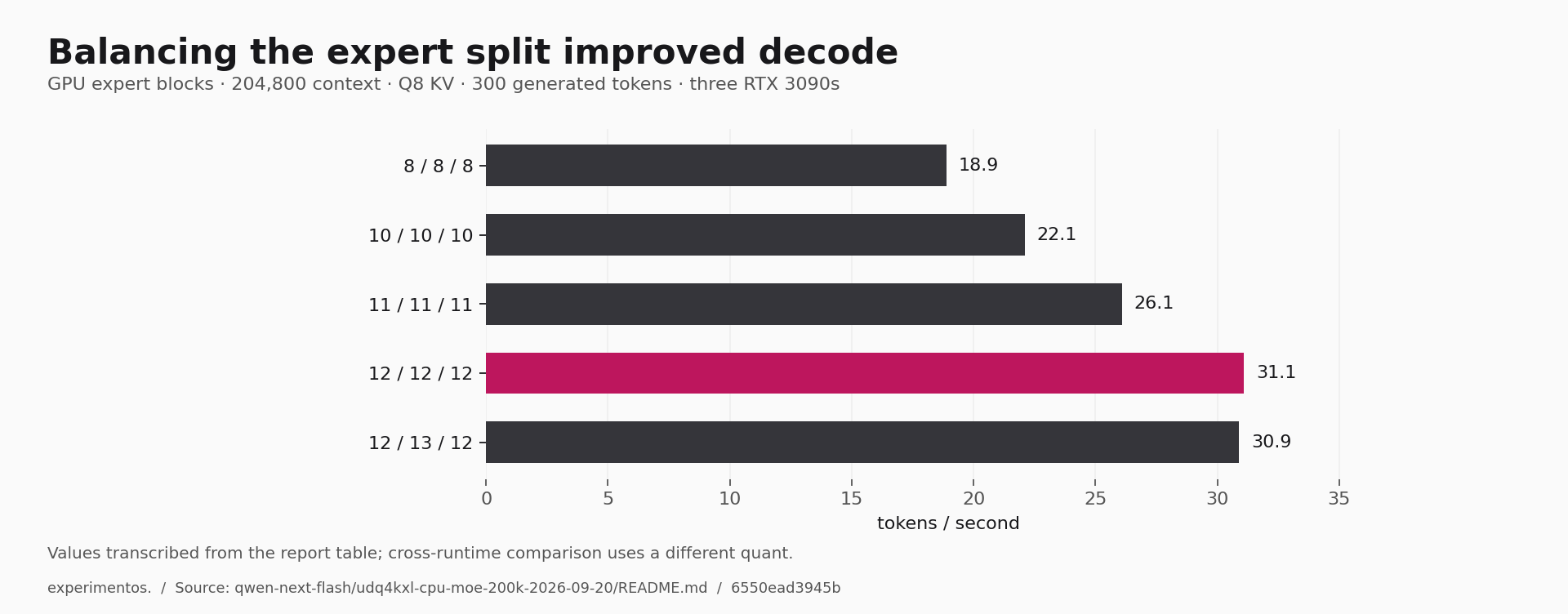
Values transcribed from the report table; cross-runtime comparison uses a different quant.
View data & source
| Configuration | Value |
|---|---|
| 8 / 8 / 8 | 18.9 |
| 10 / 10 / 10 | 22.1 |
| 11 / 11 / 11 | 26.1 |
| 12 / 12 / 12 | 31.1 |
| 12 / 13 / 12 | 30.9 |
Origin: reported table. Revision 6550ead3945b.
Write-ups
Report qwen-next-flash/udq4kxl-cpu-moe-200k-2026-09-20/README.md
The question
The quant was larger than the three GPUs could hold on their own. The experiment tested explicit GPU expert splits with CPU offload and measured the decode effect under the same large-context workload.
From the original notebook
- Date: 2026-09-20 (single-day run)
- Host: 3x RTX 3090 (72 GB VRAM), 125 GB RAM, i7 CPU
- Model:
unsloth/Qwen3.8-Flash-Next-GGUFUD-Q4_K_XL — 4-part multipart GGUF, 104 GiB total (~130B MoE, 48 blocks, 512 experts/10 active, only 12 full-attention blocks) - Inference: llama.cpp flash-next fork
WORKSTATION/llama-server(build 0.3.0-dev, commit 9723942), launched viaWORKSTATION/run_qwen38_flash_next_q4km.sh - Serving: port 12705, name
flashnext-udq4kxl-200k, ctx 204800, KV q8_0 - Winner: expert blocks 12/12/12 per GPU + 12 blocks CPU + PLE on CPU → 31.1 tok/s
1. Download
aria2c hard-caps -x at 16 connections/server (165 impossible). Parallelism via 3 tmux sessions, one part each:
aria2c -x16 -s16 -k8M -c <url>. All 4 parts verified byte-exact vs HF metadata (part1 10,946,624 B … part4 12,087,983,520 B).
Model path points at part1; llama.cpp concatenates multipart GGUFs transparently.
2. The load problem: 104 GiB vs 72 GB VRAM
Obligatory CPU offload of ~25 GiB of MoE experts. Key findings:
-ncmoe N+-sm layeris a trap: layer-split ignores weight; with first-N experts on CPU, GPU0 (early, near-empty blocks) idles while GPU1/2 get overloaded contiguous buffers (repeatablefailed to allocate CUDA1 buffer of size 15788813824).-otseparator is COMMA, not semicolon — semicolons giveunknown buffer type.LOAD_MODE=noneis REQUIRED with CPU-otrules: mmap + CPU overrides double-allocate.- Historical tensor names from
run_qwen38_flash_next_q4km.sh.bak-20260905still valid:blk.N.ffn_{gate|up|down}_exps.weight,per_layer_token_embd.weight(PLE). - Explicit per-GPU expert-block ranges are the only reliable placement; everything else rides
the script’s baseline (
-ngl 999 -sm layer -ts 1,1,1 -fa on --repack --op-offload -b 16384 -ub 400 -t 14 --cpu-strict -Cr 0-13).
3. Speed A/B: expert blocks on GPU (204800 ctx, q8_0 KV, 300-token streaming bench)
| GPU expert blocks | VRAM GiB (0/1/2) | CPU blocks | gen tok/s |
|---|---|---|---|
| 8/8/8 (24 total) | 17.3 / 16.0 / 16.6 | 24 | 18.9 |
| 10/10/10 (30) | 20.3 / 19.0 / 19.6 | 18 | 22.1 |
| 11/11/11 (33) | 21.8 / 20.5 / 21.3 | 15 | 26.1 |
| 12/12/12 (36) — winner | 23.3 / 22.0 / 22.8 | 12 | 31.1 |
| 12/13/12 (37) | 23.3 / 23.5 / 22.8 | 11 | 30.9 (plateau, tighter GPU1) |
Balanced splits beat unbalanced at equal block count (a 12/3/7 accidental split gave only 19.5 — pipeline stalls on the empty GPU dominate). 12/12/12 = same speed as 12/13/12 with better margins → production choice.
4. Verdict & context
- 31 tok/s is the physics ceiling for this quant on this host: ~25 GiB of experts must run on CPU
(
--op-offload). Reference points: old all-GPU Q4_K_M M64 did 60.5 tok/s @ 204800/q8; exl3-4bpw (all-GPU, 65.1 GB weights) did 67.6 tok/s @ 265984/q8, 66.3 @ 307200/q6. - exl3-4bpw beats UD-Q4_K_XL ~2x on speed AND reaches larger ctx, but costs 102 GB disk vs 104 GB and lacks GGUF ecosystem flexibility. This GGUF run is the llama.cpp-native deployment.
- Model fine at 204800/q8 with ~0.7 GiB margin on GPU0; higher ctx would need KV q6 or fewer GPU blocks.
5. Files
scripts/run_udq4xl.sh— winning launch wrapper (12/12/12 + PLE→CPU + LOAD_MODE=none)scripts/bench_gen.py— streaming gen tok/s benchmark- Live server: tmux/setsid, log
/tmp/udq4xl-server.log, healthcurl localhost/health
Not yet wired into qwen36_model_families.json (proxy family pending decision).
Keep exploring
Original experiment record. Workstation paths have been generalized. Detailed measurements below retain their original workload and validation boundaries.
Supporting notebooks
More in Language models
An unfinished gauntlet cannot name a winner
This campaign compared Qwen UD-Q4_K_XL with MTP2 against Bonsai through coding harnesses. It stopped at the 70 GiB free-space guard, retaining the incomplete evidence rather than risking the workstation.
The 15 matched cells tied: six passes and nine failures for each model.
A context setting is not a context test
A server can accept a large context configuration without demonstrating useful work at that length. I separated configured capacity, an actual request, and a successful result before making another speed claim.
The largest verified successful coding prompt was 49,124 tokens; larger configured windows remained unproven.
Finding a local model for the inbox
Inbox work needs accurate structured answers and reasonable response times. The benchmark ran the same 50 tasks across local model, runtime and hardware configurations, with thinking on and off, to make that tradeoff visible.
Bonsai-2-27B PQ2_0 with MTP passed 48/50 tasks with thinking on, at a 15.8-second median on an RTX 3060.